
TIFT Services Ltd
AD & Biomethane Consultancy
Exploring the Role of Biomethane in the Energy System to 2050: A TIFT Services Ltd Review.

The National Energy System Operator (NESO) has published its landmark report, "Exploring the Role of Biomethane in the Energy System to 2050", and it lands at a pivotal moment for the UK's anaerobic digestion sector. With the Green Gas Support Scheme (GGSS) closing to new applications in March 2028 and government consultation on a successor framework expected imminently, this report sets the strategic direction for biomethane's place in the UK's net zero future.
At TIFT Services Ltd, we've reviewed the full 31-page document so you don't have to wade through every policy nuance. Below, we break down what it actually means, whether you're running a plant, planning one, buying green gas, or simply paying a gas bill.
If you're already running an AD plant, this report is both validation and a call to action.
Your asset class just got a strategic endorsement. NESO explicitly recognises biomethane as a long-term component of the UK energy mix, not merely a transitional technology. The report positions biomethane alongside hydrogen and carbon capture and storage (CCS) as one of three pillars of the future low carbon gas supply. That's significant. It means your operational expertise is going to be in demand for decades, not just until the next subsidy round closes.
Secondary revenue streams are now front and centre. The report highlights that operators can already leverage additional revenues from green gas certificates, gate fees for waste treatment, and CO₂ utilisation markets. NESO goes further, flagging that carbon capture from biomethane production could deliver greenhouse gas removals at £84–£213 per tonne of CO₂, considerably cheaper than direct air capture (£325–£842/tCO₂) or retrofitting energy-from-waste plants with CCS (£221–£347/tCO₂). If you're not already capturing your biogenic CO₂, this is the clearest signal yet that it's worth investigating.
Even very small proportions of leakage along the supply chain can significantly undermine the climate benefits of biomethane.
Methane leakage monitoring is non-negotiable. NESO is unambiguous on this point. The report references previous studies that identified "unacceptable leakage rates" at some sites, while acknowledging that stakeholders say sub-1% leakage is achievable with modern technologies. Operators who invest in leak detection and repair (LDAR) programmes now will be ahead of whatever regulatory tightening follows.
Grid constraints are coming for you. Curtailment of biomethane injection during low-demand periods is already happening, particularly in summer months. As overall gas demand falls and biomethane production rises, these constraints will intensify. The report flags that investment in smart pressure control and reverse compression can help, and that Regional Energy Strategic Plans (RESPs) will set the direction for gas distribution network planning. Operators need to be engaging with their gas distribution network operators now, not when their injection is curtailed.
Propanation costs remain a drag. Biomethane's lower calorific value compared to natural gas means operators must currently add small quantities of propane before grid injection. NESO acknowledges this as a barrier to growth and notes that alternative routes to fair billing are being explored. Any change here would directly improve project economics.
If you're planning a new AD plant or biomethane upgrading facility, this report reshapes the investment landscape.

The 30 TWh floor is your baseline case. NESO's analysis indicates that scaling to 30 TWh by 2050 is achievable without triggering material cross-sector dependencies or trade-offs. That's five times today's production, meaning there is substantial room for new projects. The ambition could go higher (FES 2025 explores up to 64 TWh), but beyond 30 TWh, a formal cross-sector assessment of appropriate ambition becomes necessary.
Scale matters more than ever. The report makes clear that larger AD assets push production costs towards the lower end of the £73–£135/MWh range. Industry stakeholders have told NESO that current support mechanisms create challenges in delivering larger assets. If the successor to the GGSS is designed with scale in mind, it could fundamentally change project economics. Developers should be building optionality into their designs. Plan for expansion, even if you commission at a smaller capacity.
Feedstock strategy is your make-or-break decision. NESO identifies five feedstocks with the most growth potential: grassland, rotational crops, sequential crops, agricultural residues and livestock waste. Each comes with its own dependency profile. Waste-based feedstocks carry lower emissions and sustainability risks, but crop-based feedstocks unlock the higher production volumes. The current GGSS requires a minimum 50% waste content for subsidised biomethane, but the external analysis underpinning NESO's work assumes a future mix of one-third waste to two-thirds crops. Getting your feedstock supply agreements right, and understanding how the policy framework around crop-based biomethane evolves, is critical.
Grid connection remains a major risk factor. Developers have historically faced slow and complex grid connection processes, with each network operator setting different requirements. NESO notes that work is underway to standardise processes and equipment, and that National Gas is working to reduce connection times for transmission-level connections. However, the report also warns that constraints in some distribution network areas are becoming more restrictive, limiting where new plants can connect. Early engagement with network operators is essential.
Roughly half of the gas demand from hard-to-electrify industrial processes comes from sites outside industrial clusters, sites that won't have access to hydrogen pipelines or CCS.
Location strategy should consider dispersed industry. One of the most striking findings is that roughly half of the gas demand from hard-to-electrify industrial processes in GB comes from sites outside industrial clusters, sites that won't have access to hydrogen pipelines or CCS infrastructure. Biomethane may be the most practical long-term decarbonisation route for these dispersed sites (glass works, ceramics producers, and similar). Developers who position their plants to serve these off-grid industrial customers could be tapping into a premium market.
The GGSS successor is everything. The report couldn't be clearer: without a future policy framework to follow the GGSS, growth in the sector is likely to stall. Government is expected to consult on successor arrangements, and the strength of that framework will determine whether the 30 TWh floor, let alone anything above it, becomes reality. Developers need to be actively engaging with the consultation process.
If you're buying biomethane, whether through green gas certificates, the RTFO, or direct supply, this report signals both opportunity and uncertainty.
Industrial off-takers outside clusters should be paying close attention. NESO's analysis identifies dispersed, hard-to-electrify industrial sites as one of the highest-value end uses for biomethane. If your site isn't near an industrial cluster and you currently rely on natural gas for high-temperature heat or chemical processes, biomethane could be your most viable long-term decarbonisation option. The UK Emissions Trading Scheme doesn't currently recognise grid-injected biomethane, but government is exploring how to change this. When that recognition comes, early movers will benefit.
Transport operators face a complex picture. Gas-powered HGVs running on biomethane are currently outpacing electric HGV uptake, driven by organisations with internal decarbonisation targets (major supermarkets, logistics firms). The RTFO and reduced fuel duty for methane support this trend. However, NESO raises a significant caution: methane leakage from vehicle engines, particularly at low loads, and from LNG storage for shipping could offset much or all of the emissions savings. Long-term pathways from the Climate Change Committee assume a limited role for biomethane in transport, partly because of leakage concerns. Off-takers in HGV fleets should monitor the evidence on leakage carefully and consider whether electric alternatives might overtake biomethane sooner than expected.
Shipping and aviation represent emerging demand. LNG uptake in shipping is growing, driven by EU FuelEU emissions targets, and bioLNG is expected to contribute to decarbonisation of these vessels over time. In aviation, the UK SAF Mandate is creating demand for sustainable aviation fuels, some of which use biomethane as a feedstock or compete with biomethane for the same feedstocks. The interplay between these markets will shape future biomethane pricing and availability.
Power generators should note the cost modelling. NESO's capacity expansion modelling shows that making biomethane available for low carbon dispatchable power reduces the overall cost of the future power system by lowering the need for new generation assets and infrastructure. This benefit is most pronounced when biomethane is used in geographically distributed gas plants that don't require hydrogen pipeline or CO₂ network access. For flexible generation operators, biomethane could be a pragmatic route to low carbon dispatch without the infrastructure dependencies of hydrogen-to-power or gas CCS.
The benefits of biomethane can only be fully unlocked if there is confidence in future production volumes and clarity on which sectors will have access.
Confidence in supply volume is the missing piece. NESO's central message to off-takers is this: without a government-led strategic framework that sets a production ambition and identifies priority end uses, off-takers can't make the long-term investment decisions needed to realise the full value chain benefits.
This is the section that rarely makes it into industry newsletters, but it matters.
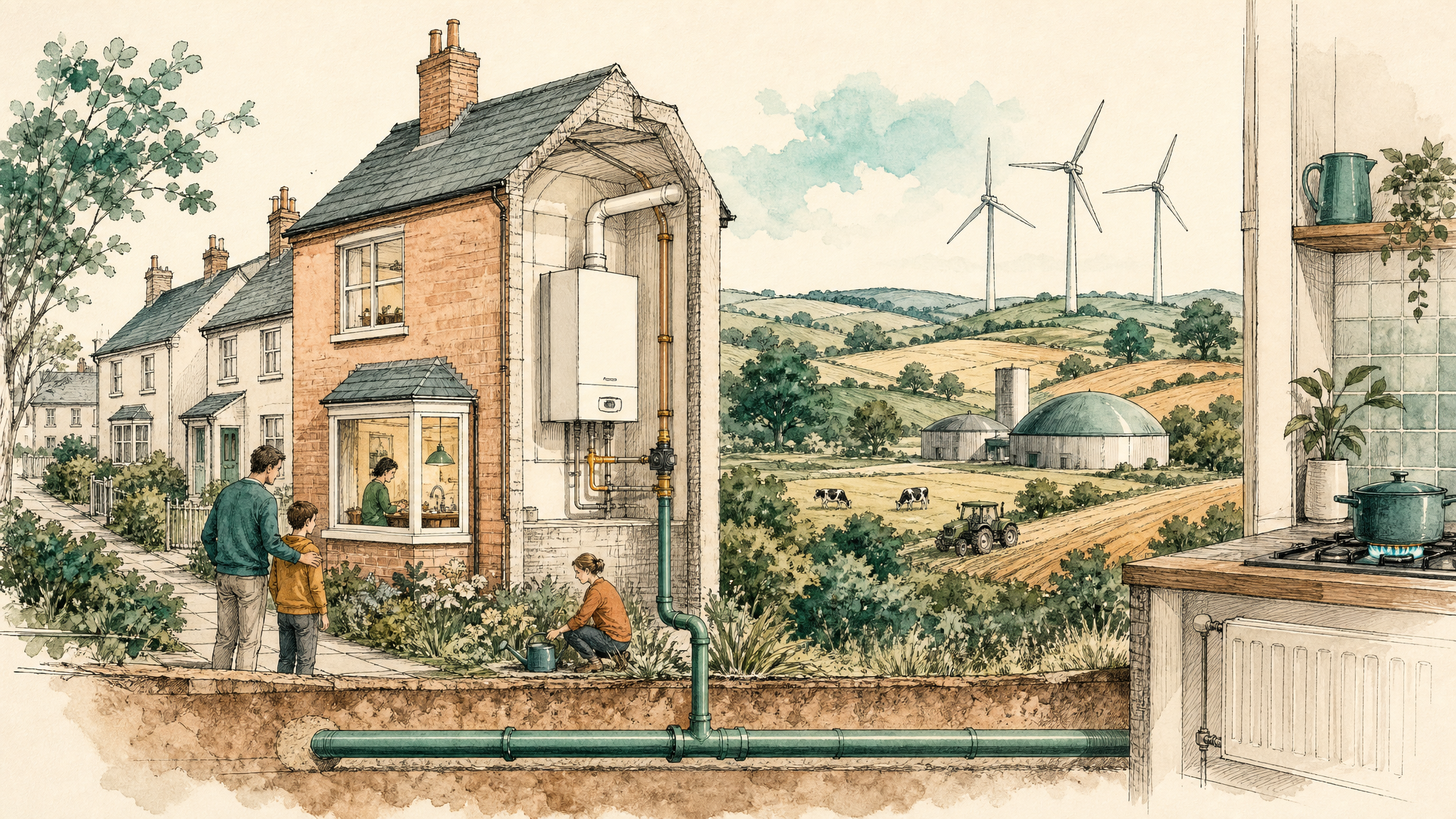
Your gas bills could come down. NESO's modelling shows that using biomethane in power generation could reduce the total cost of the future power system. Fewer new gas plants, hydrogen facilities and associated infrastructure means lower capital costs that ultimately flow through to consumer bills. These savings are contingent on biomethane being strategically planned into the system, rather than emerging ad hoc.
Biomethane tackles waste that would otherwise release methane. Food waste, sewage sludge and animal manures naturally decompose and release methane, a greenhouse gas roughly 80 times more potent than CO₂ over a 20-year period. Anaerobic digestion captures that methane and converts it into useful energy. Every tonne of waste diverted into AD is a tonne that isn't decomposing in a landfill or being spread untreated on farmland.
It supports British farming. The report envisions a future where farmers earn additional revenue by supplying feedstocks, including livestock waste, crop residues, rotational and sequential crops, to AD plants. Digestate from the process replaces imported chemical fertilisers, supporting nutrient circularity and reducing reliance on fossil fuel-derived inputs. This isn't abstract policy: it's money in farmers' pockets and less dependence on volatile global fertiliser markets.
Energy security improves. Biomethane is produced domestically from UK feedstocks. Unlike natural gas, its price isn't subject to international geopolitical shocks. Scaling up domestic biomethane production is a direct contribution to energy independence, something that has taken on renewed importance since the global energy price crisis.
But sustainability must be genuine. NESO is clear that biomethane only delivers its climate benefits if it's produced sustainably. That means rigorous greenhouse gas criteria across the full supply chain, protection of biodiversity, preservation of high-carbon-stock land, and prevention of soil degradation. The public should expect, and demand, that these standards are enforced, not just stated.

Unlike hydrogen or direct air capture, biomethane is already produced and injected into the grid today. Over 120 plants are doing it right now. The technology works, the supply chain exists, and the regulatory framework is established.
At £73–£135/MWh, biomethane is already within the range of projected hydrogen costs, without requiring purpose-built pipeline infrastructure. It uses the existing gas grid, which is a massive infrastructure advantage.
Gate fees, green gas certificates, GGSS tariffs, RTFO certificates, biogenic CO₂ sales, digestate as fertiliser. Biomethane operators can stack revenues in ways that few other renewable technologies can match.
Carbon capture from biogas upgrading is well-established and could deliver greenhouse gas removals at a fraction of the cost of alternatives. With CO₂ transport and storage networks coming online, this could become a significant revenue stream.
Biomethane production is inherently local. It uses local feedstocks, employs local people, and serves local networks. It doesn't require the concentrated infrastructure of offshore wind or nuclear.
Biomethane is chemically almost identical to natural gas. It doesn't require new boilers, new pipework, or new appliances. That's a massive practical advantage over hydrogen, which requires extensive conversion of end-use equipment.
Unlike wind or solar, biomethane is constrained by feedstock availability. Even the most optimistic assessments don't see it exceeding 64 TWh by 2050, significant, but still a fraction of current gas demand (~700 TWh). It's part of the solution, not the whole solution.
The cost gap between biomethane and natural gas requires policy support to bridge. Without a successor to the GGSS, growth will stall. This creates investment uncertainty that the sector has been living with for years.
Getting beyond 30 TWh involves increasing reliance on crop-based feedstocks, which carry higher sustainability risks: competition with food production, soil health impacts, and higher lifecycle emissions (particularly from grassland). The cross-sector assessment NESO calls for has not yet happened.
The gas distribution network wasn't designed for high levels of injection. Summer curtailment is already a reality in some areas, and connection processes remain slow and inconsistent. Solving this requires investment and regulatory attention that has been slow to materialise.
The climate case for biomethane rests on minimising leakage. If leakage exceeds even a few percent, the greenhouse gas benefits can be wiped out. This is particularly acute for transport applications where engine slip and storage losses create additional emission sources.
Biomethane's current uses are shaped by sector-specific policies (GGSS for heat, RTFO for transport) rather than a coherent cross-sector strategy. The UK ETS doesn't recognise grid-injected biomethane. This patchwork approach means biomethane isn't necessarily flowing to where it can deliver the most value.
NESO's report is a call for coordinated action. Here's what needs to happen next, and who needs to do it.

The absence of a specific biomethane target for GB is holding the sector back. Whether it's 30 TWh, 50 TWh, or 64 TWh, the industry needs a number to plan around. That number must be set through the cross-sector collaboration NESO describes: energy, agriculture, environment, and waste all need to be at the table.
The current scheme closes to new applications in March 2028. The consultation on successor arrangements must happen promptly, and the framework needs to address the sector's specific calls: support for larger assets, recognition of secondary revenue streams, and clarity on crop-based feedstock eligibility.
Until the ETS differentiates biomethane from natural gas for grid-connected industrial sites, there is no market signal for industry to switch. Government is already exploring this. It needs to act.
Smart pressure control, reverse compression, and network reinforcement are needed in constrained areas. The RESPs being developed by NESO should provide the planning framework, but investment decisions can't wait for perfect information.
Most biomethane plants are small and geographically spread. They'll need CO₂ trucking solutions to reach piped networks, and the policy and regulatory framework for non-pipeline CO₂ transport must be developed.
NESO is right that getting beyond 30 TWh requires an honest, evidence-based conversation about trade-offs with food production, biodiversity, soil health, and land use. That conversation should start now, not when the 30 TWh milestone is approaching.
Industry claims sub-1% leakage is achievable. This needs to be verified, standardised, and mandated, particularly if biomethane is to be used in transport where additional leakage sources exist.
At TIFT Services Ltd, we work across the entire AD and biomethane value chain. This NESO report reinforces the areas where we see clients needing the most support.

We provide technical consultancy on plant optimisation, process control, and operational efficiency. If you're looking to reduce your levelised cost of production, improve biogas yields, explore CO₂ capture opportunities, or implement a robust LDAR programme to stay ahead of tightening leakage standards, we can help. Our expertise in digestate management and nutrient recovery is directly relevant as the sector scales and digestate volumes increase.
From feasibility studies and business plan development through to financial modelling, planning applications, and technology selection, we support projects from concept to commissioning. The NESO report makes clear that scale, feedstock strategy, and grid connection are the three pillars of a successful new project, and these are exactly the areas where our experience adds value. We can help you navigate the complexities of the GGSS successor framework as it emerges and position your project for the policy landscape ahead.
If you're a dispersed industrial site looking at your decarbonisation options, we can assess whether biomethane is the right fit for your process, model the economics, and help you structure an offtake agreement. For fleet operators considering biomethane-fuelled HGVs, we can provide an honest appraisal of the emissions case, including leakage considerations, against electric alternatives.
The NESO report provides the strategic underpinning for long-term confidence in the biomethane sector. We can support due diligence, independent technical reviews, and market assessments to help you make informed investment decisions in this growing market.
We contribute to industry consultations, support cross-sector engagement, and help clients articulate their position in the policy debates that will shape the future of biomethane in the UK. With NESO calling for cross-sector collaboration as the next critical step, having an experienced partner who understands both the technical and policy landscape is more important than ever.
This is one of the most significant publications the UK energy sector has seen on the future of biomethane. NESO isn't just saying biomethane has a role. It is saying that without strategic planning and cross-sector collaboration, the UK will fail to capture the full value that biomethane can deliver.
The 30 TWh floor is a strong, evidence-based starting point. The potential to go higher exists, but it requires difficult conversations about land use, farming, food security and environmental protection that no single sector can resolve alone.
For those of us who work in this industry, the message is clear: the opportunity is substantial, the technology is proven, and the policy window is opening. But it won't stay open indefinitely. The next 18 to 24 months, as the GGSS successor takes shape, the UK ETS evolves, and the RESPs are developed, will define the trajectory of biomethane in the UK for the next quarter-century.
Get in touch with TIFT Services Ltd if you'd like to discuss what this report means for your specific situation. We're here to help you navigate the opportunities ahead.
Whether you're operating, developing, buying or funding, TIFT Services Ltd can help you turn NESO's strategic direction into a practical plan.
