
E is for Emissions, Energy Efficiency, Economics and Environmental Permitting
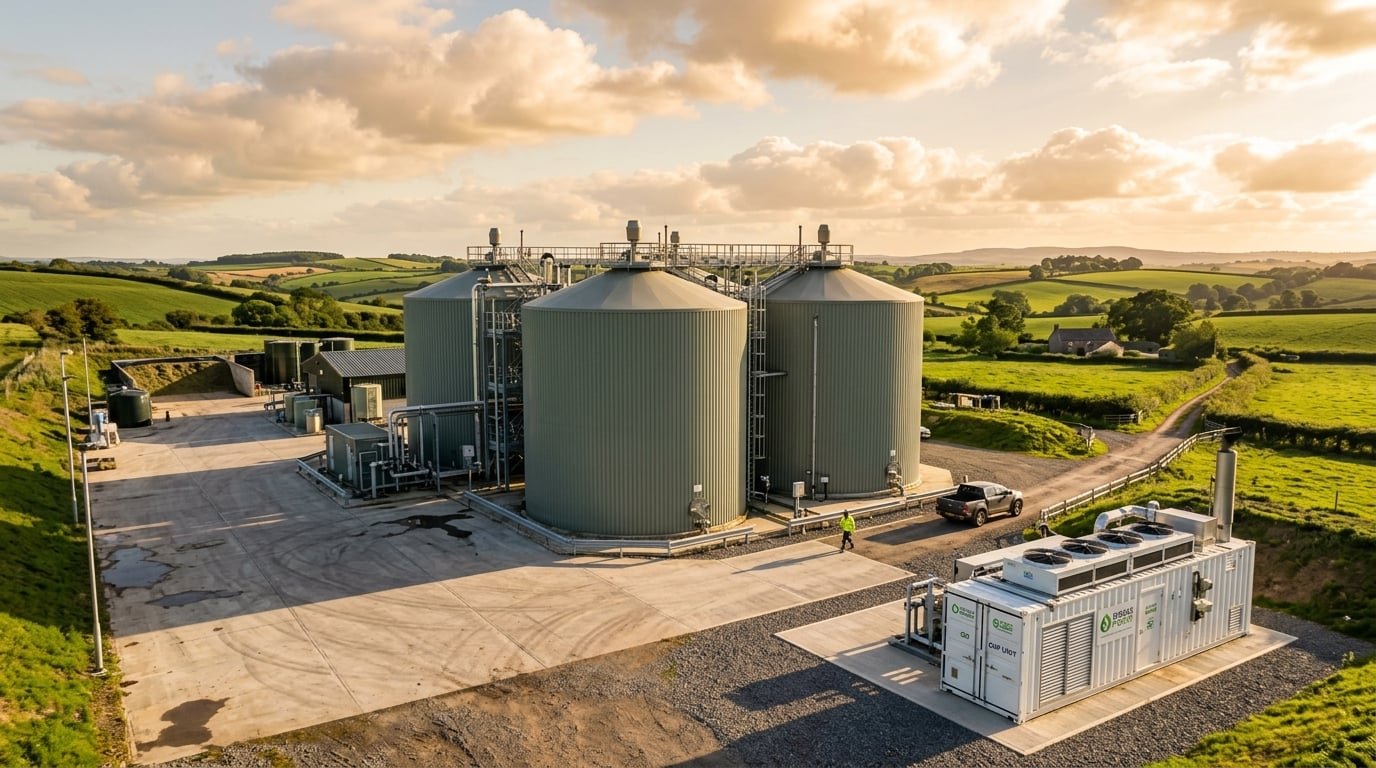
As we continue our A-Z of Anaerobic Digestion, we arrive at the letter E – and with it, four of the disciplines that most often separate a well-run facility from a struggling one: Emissions, Energy Efficiency, Economics, and Environmental Permitting. Following on from our look at Digestate, Degradation Rates and Design, this entry moves from the biology of the process to the regulatory and commercial framework that determines whether a site remains compliant, profitable, and defensible.
The operational success of an anaerobic digestion (AD) facility is defined by far more than its methane yield. In the contemporary regulatory landscape, technical excellence must encompass the precise management of point-source emissions, the maximisation of net energy recovery, and strict adherence to the conditions of an environmental permit. As the UK moves further into the implementation of the Medium Combustion Plant Directive (MCPD) and more rigorous Environment Agency (EA) oversight, operators can no longer treat these "E" factors as afterthoughts – they must be integrated into the core management strategy of the site. At TIFT Services Ltd, we provide the technical expertise necessary to navigate these complexities, ensuring your site remains both compliant and efficient.
Emissions Control: Stack Testing Requirements
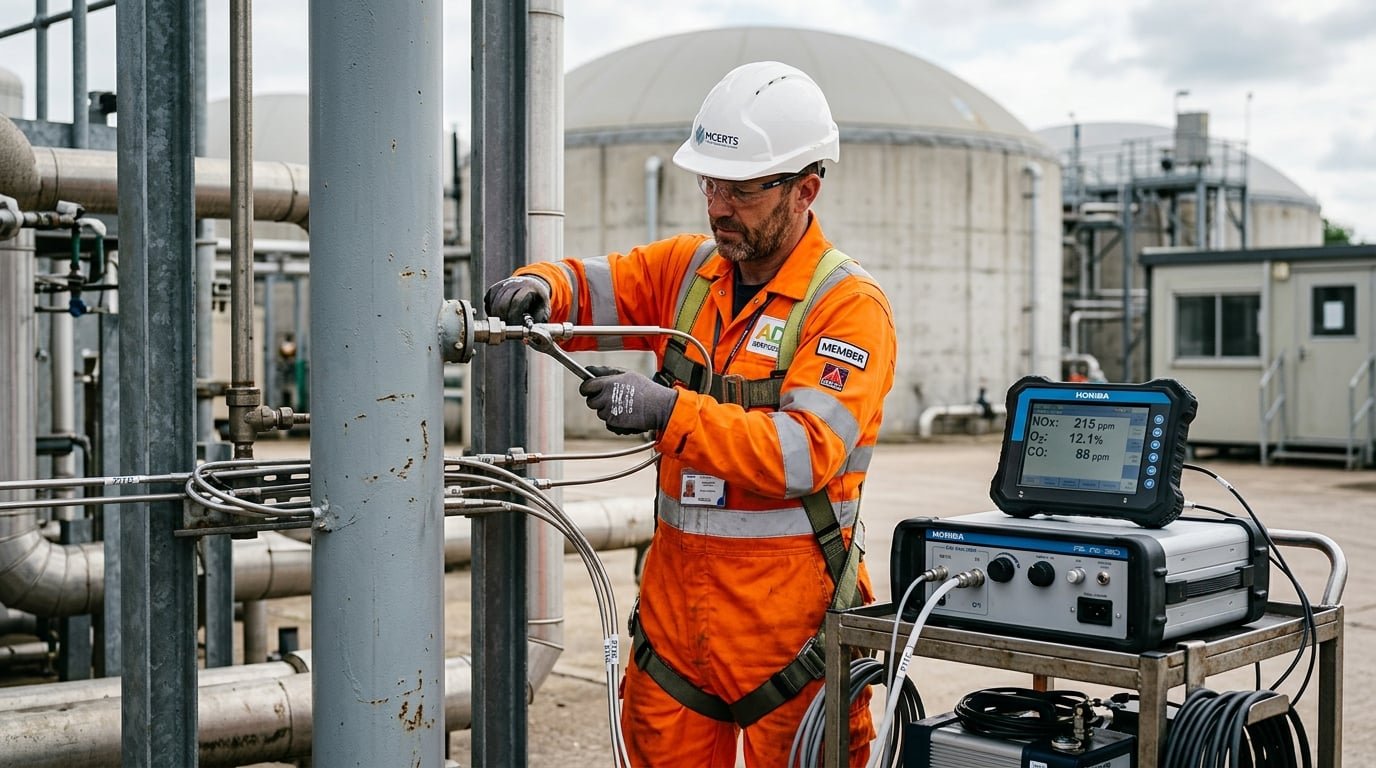
Point-source emissions from Combined Heat and Power (CHP) engines and auxiliary boilers are a primary focus for environmental regulators. Under the Environmental Permitting (England and Wales) Regulations 2016, most AD facilities that burn biogas are required to undertake periodic stack monitoring to demonstrate that emission limit values (ELVs) set in the permit are not being exceeded. This is not a paper exercise: emissions data is one of the clearest ways in which the regulator judges whether a combustion plant is being properly maintained and operated.
CHP Engines and Boiler Methodology
For gas engines burning biogas, the EA typically mandates monitoring at least annually, with the exact frequency set by the permit. This work must be conducted in accordance with the EA's Monitoring stack emissions: environmental permits guidance, using MCERTS-certified personnel and accredited equipment, and reported by an organisation holding the appropriate MCERTS accreditation. The primary determinands and their reference methods include:
- Nitrogen Oxides (NOx): measured by chemiluminescence in accordance with BS EN 14792. NOx is almost always the critical parameter for lean-burn biogas engines and the one most likely to drift out of specification as an engine ages or falls out of tune.
- Carbon Monoxide (CO): measured by non-dispersive infrared spectroscopy (NDIR) per BS EN 15058. CO is an excellent indicator of combustion completeness and engine health – a rising CO trend often precedes a formal exceedance.
- Sulphur Dioxide (SO₂): determined through BS EN 14791, or in some permits by calculation from the measured hydrogen sulphide (H₂S) content of the biogas. This is where effective upstream desulphurisation directly reduces your stack emissions.
- Total Volatile Organic Compounds (VOCs): including unburnt methane, measured by flame ionisation detection (FID) under BS EN 12619. Methane slip through the engine is both an emissions issue and a lost-revenue issue.
Reference-oxygen trap: Emissions are reported as dry gas at 273.15 K and 101.3 kPa, corrected to a standardised oxygen concentration. Historically, many bespoke permits for biogas engines referenced results to 5% O₂, whereas the MCPD standardises engine ELVs to 15% O₂. Comparing a result at one reference oxygen level against a limit set at another will produce a meaningless – and potentially non-compliant – number. Before any test campaign, confirm exactly which reference condition your permit specifies.
Representative sampling also depends on the physical design of the stack. Sampling ports must be correctly positioned and sized to meet BS EN 15259, which sets requirements for the measurement section, the number and location of sampling points, and the minimum straight lengths of duct upstream and downstream of the ports. Retrofitting compliant ports to an existing flue is far more expensive and disruptive than designing them in from the outset, so this is a detail we always review at the design stage.
Failure to meet the ELVs, or to use the correct methodology and reference conditions, can result in a compliance breach, a Compliance Assessment Report (CAR) score against the permit, and potential enforcement action. Trending your emissions results year-on-year – rather than treating each test as a pass/fail snapshot – is the most effective way to catch a deteriorating engine before it becomes a regulatory problem.
The Role of Flare Efficiency in Emissions Management
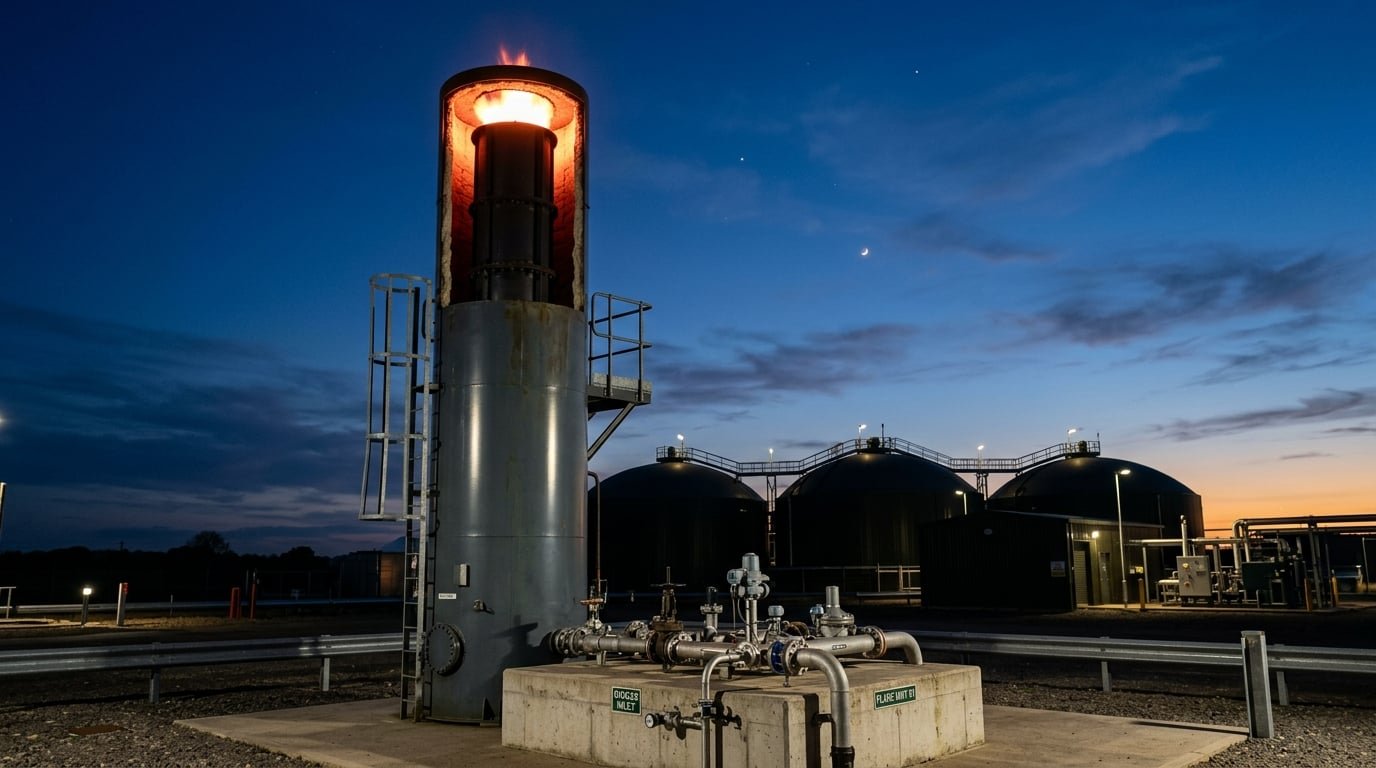
Flares are critical safety and environmental control devices on AD sites, intended to manage gas pressure and combust biogas safely during plant upsets, maintenance, or emergencies. However, the EA does not support the routine flaring of biogas: a flare represents both a wasted renewable resource and a source of emissions, and excessive flare runtime is treated by the regulator as a symptom of poor plant management.
Automated Flare Systems
Modern AD facilities use automated, high-efficiency enclosed ground flares rather than simple open candlestick flares. By enclosing the combustion within a refractory-lined shroud, these systems shield the flame, control the air-to-gas ratio, and maintain the conditions needed for near-complete combustion. A well-specified enclosed ground flare is designed to achieve a methane destruction and removal efficiency of around 98–99% by holding three variables within design limits: combustion temperature, residence time, and turbulence (the "three Ts" of combustion).
Key regulatory and technical expectations for flares include:
- Combustion temperature: the combustion zone is typically designed to operate in excess of 1,000 °C, with permit conditions commonly specifying a minimum operating temperature that must be logged. Adequate residence time (often at least 0.3 seconds at temperature) is required to ensure the destruction of methane and trace VOCs.
- Runtime limits: if an auxiliary flare exceeds a runtime threshold set in the permit – often referenced against an annual percentage of operation – operators may be required to undertake formal stack testing of the flare itself, rather than relying on the manufacturer's design specification.
- Recording requirements: every instance of auxiliary flare operation, together with any pressure-relief valve (PRV) activations, must be recorded in the site's Environmental Management System (EMS), with the cause investigated. A flare event is a data point about plant reliability, not merely a safety action to be logged and forgotten.
Key takeaway: Every cubic metre of biogas sent to the flare is a cubic metre not converted to electricity, heat, or biomethane. The best defence against high flare runtime is adequate gas storage buffering, high CHP or upgrader availability, and robust biological stability so that gas production and gas utilisation stay in balance.
Navigating Environment Agency Permit Variations
An environmental permit is not a static document. As a facility grows, changes its feedstock, or upgrades its plant, the existing permit may no longer authorise what the site actually does – and operating outside your permit is a serious offence. An Environmental Permit Variation is the formal mechanism for bringing the permit back into line with the operation.
Triggers for Variation
Common triggers for a permit variation in the AD sector include:
- Increased thermal capacity: if the aggregate rated thermal input of biogas-fired appliances (excluding flares) increases, a site may cross a threshold that requires it to move from a Standard Rules permit to a Bespoke Permit, or to add new combustion plant conditions. Standard Rules permits (such as the EA's SR2012 series for on-farm and waste AD) come with fixed eligibility limits; exceeding them means a bespoke application.
- MCPD integration: the installation of new medium combustion plant (1–50 MWth net rated thermal input) requires registration or permitting under the MCPD and the setting of the associated ELVs. New plant has required compliance since December 2018; existing plant of 5–50 MWth has already passed its registration deadline (1 January 2024), while existing plant of 1–5 MWth must be registered by 1 January 2029 – a deadline that is now firmly on the horizon for many farm-scale operators.
- Feedstock changes: modifying the types, sources, or volumes of organic material processed on site – for example, introducing food waste or a new industrial by-product – frequently requires a variation to the permitted waste codes and may bring Animal By-Product (ABP) obligations into play.
The Importance of the EMS
Central to any permit – and to any variation – is an up-to-date Environmental Management System (EMS). The EMS is the master document that demonstrates to the regulator how the operator controls and monitors emissions to air, water, and land. It brings together the site's written management procedures, incident and accident response plans, preventive maintenance schedules, monitoring records, complaints logs, and technical competence records into a single coherent system.
A robust EMS is what separates a proactive, capable operator from a reactive one in the eyes of the regulator, and it directly influences the site's Compliance Assessment Report scoring and subsidy (regulatory) charges. We advise clients to treat the EMS as a living operational tool that is reviewed and updated as the site changes – not a folder that is written once for the permit application and then left on a shelf. When a variation is required, an EMS that already reflects reality makes the application faster, cheaper, and far more likely to succeed first time.
Energy Efficiency: Optimising Net Output
Energy efficiency in anaerobic digestion is not solely about how much biogas the plant produces – it is about the net energy delivered to the meter or the grid after the plant has powered itself. High parasitic loads, the energy consumed by the plant's own equipment, can quietly erode both the commercial return and the carbon credentials of an otherwise well-performing facility.
Identifying and Reducing Parasitic Loads
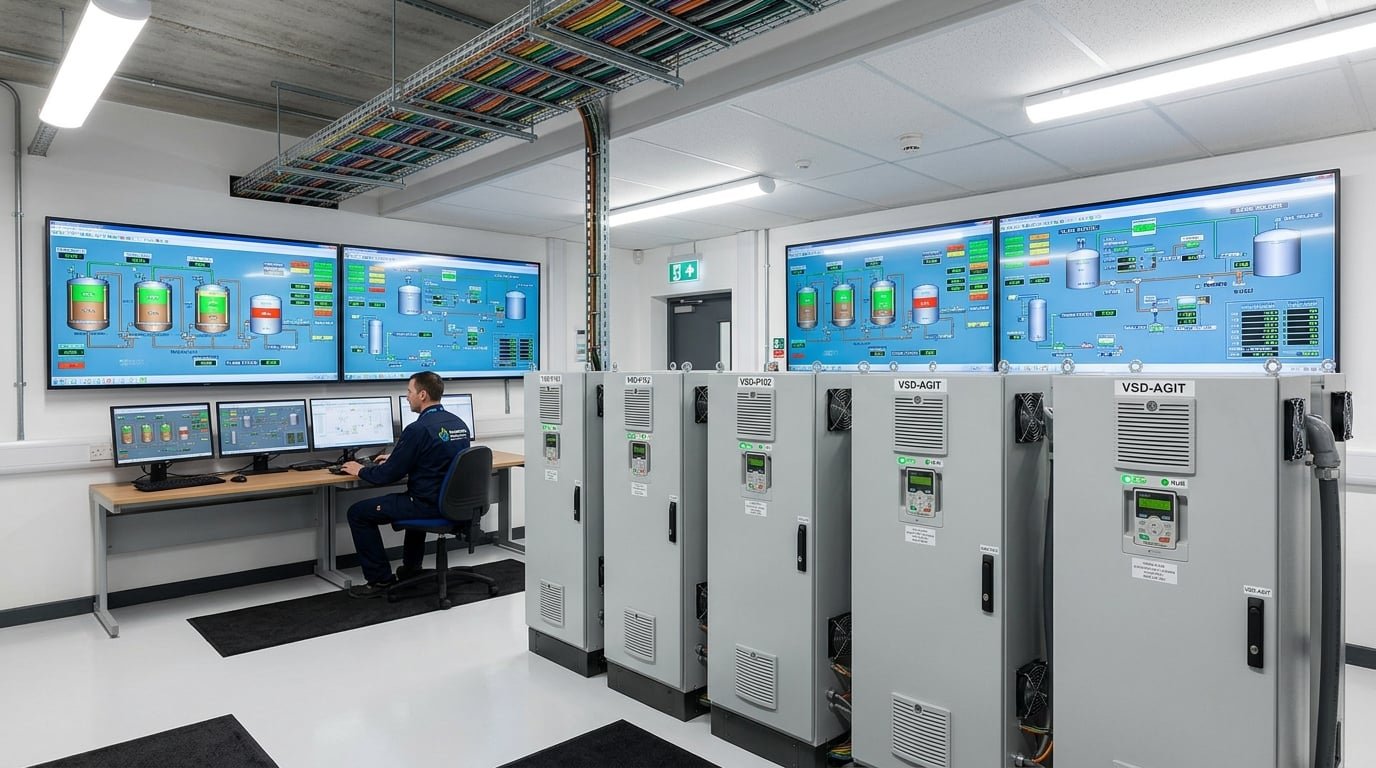
Parasitic electrical load on a typical AD plant commonly falls in the region of 8–15% of gross generation, and can be higher still on sites with energy-intensive biogas upgrading or extensive pre-treatment. The largest consumers are usually mixers, feed and recirculation pumps, feedstock pre-treatment and de-packaging systems, and – where fitted – the biogas upgrading plant. To bring this load under control, we recommend:
- Energy auditing: quantifying the consumption of every major motor and heater to build a genuine site energy balance. You cannot manage what you have not measured, and sub-metering of the major drives usually pays for itself quickly by revealing where energy is being wasted.
- Variable Speed Drives (VSDs): fitting VSDs to mixers and pumps so that they can be modulated to real-time demand rather than running continuously at full load. Because centrifugal pump power scales roughly with the cube of speed, even a modest reduction in speed can deliver a disproportionately large energy saving.
- Optimised mixing schedules: using timers and load-sensing control to prevent over-mixing. Continuous full-power mixing consumes significant electricity without necessarily increasing gas yield, and can even damage the biology by shearing microbial flocs and encouraging short-circuiting.
Thermal Recovery Strategies
Maximum efficiency is achieved when the heat produced by the CHP engine is fully and usefully deployed rather than dumped to atmosphere through a radiator. Heat recovered from the engine jacket water and exhaust gases should be prioritised for:
- Digester heating: maintaining stable mesophilic (approx. 38–42 °C) or thermophilic (approx. 50–55 °C) temperatures, which is the single most important use of recovered heat on most sites.
- Pasteurisation: meeting ABP requirements – typically 70 °C for one hour – for waste-derived feedstocks and digestate, which is itself a significant and unavoidable heat demand on food-waste plants.
- External heat export: supplying local industrial processes, glasshouses, drying operations, or a district heating network. Useful heat export improves the plant's overall efficiency and carbon footprint and can open up additional revenue or incentive streams.
Demonstrating high, useful heat utilisation is not only good engineering – under several support schemes it has also been directly linked to the value of the incentive received, making thermal recovery one of the highest-leverage efficiency measures available to an operator.
The Economics of AD: Beyond Optimistic Projections
The commercial performance of an anaerobic digestion facility is often undermined not by a single dramatic technical failure, but by an accumulation of overly favourable assumptions made at the modelling stage. A financial projection can look robust on paper yet fail under operating conditions once biological variability, plant downtime, feedstock inconsistency, and compliance costs are properly represented. For this reason, sound economic assessment should be built on conservative operational data, not on best-case design intent.

Why Financial Models Fail
A common weakness in AD business planning is the direct translation of laboratory or developer assumptions into revenue forecasts without applying any operational derating. Models frequently assume stable feedstock quality, uninterrupted equipment performance, immediate ramp-up to design throughput, and consistently high methane conversion. In practice, commissioning periods run longer than planned, contamination events occur, digesters need time to reach biological stability, and maintenance interventions reduce throughput. When these realities are excluded, projected returns can materially overstate what the site will actually deliver.
Laboratory BMP Versus Real-World Degradation
Biochemical Methane Potential (BMP) testing is a valuable comparative laboratory tool, but it does not represent guaranteed plant performance. BMP values are obtained under controlled conditions with an adapted inoculum, extended retention, and an optimised digestion environment. A full-scale plant operates with hydraulic, thermal, and mechanical constraints that reduce the proportion of volatile solids actually converted to biogas. For practical financial modelling, it is generally more prudent to assume that real-world performance will achieve approximately 70% to 80% of laboratory BMP, subject to feedstock type, pre-treatment, retention time, and process stability. As we explored in our guide to degradation rates, that gap between theoretical and achieved yield is precisely where revenue forecasts are won or lost.
Uptime, Cost Assumptions, and Downside Stress-Testing
Early-stage models frequently assume plant availability of 95% or greater. For a newly commissioned or recently optimised site, this is often not a defensible starting point. During the early operational years, a more realistic expectation may be in the range of 80% to 85% uptime once planned maintenance, control-system faults, feedstock interruptions, biological instability, and CHP outages are taken into account. Applying this lower range during appraisal allows debt servicing, staffing plans, and cashflow forecasts to be tested against credible – not aspirational – operating conditions.
Cost assumptions are also regularly understated. Labour requirements tend to rise as a site moves from theoretical automation to the reality of feedstock handling, monitoring, permit administration, and contractor coordination. Maintenance expenditure is similarly vulnerable to underestimation – particularly for pumps, mixers, macerators, gas-handling systems, and CHP units running under variable load. And compliance costs must be recognised explicitly: stack testing, environmental monitoring, permit variation work, EMS upkeep, technical competence obligations, and specialist support all carry real, recurring costs that rarely appear in an optimistic first draft.
Robust appraisal should therefore include downside scenario analysis. At a minimum, a model should be stress-tested against lower-than-expected energy prices, higher feedstock or disposal costs, adverse movements in gate-fee assumptions, and commissioning delays that postpone revenue while fixed costs continue to accrue. This approach does not remove risk, but it improves decision quality by revealing which assumptions the project is most sensitive to, and where contingency and headroom are genuinely needed.
Operational Flexibility and Feedstock Diversification
Long-term resilience improves when a plant is designed and managed for operational flexibility. A facility that can accommodate variation in dry matter, contaminant load, seasonal substrate availability, and gas demand is far better placed to protect its economics when market conditions shift. Diversifying feedstock supply reduces dependence on any single waste stream or contract and strengthens commercial leverage if one substrate becomes unavailable or less favourable. Flexibility must, of course, be balanced against biological risk, permit constraints, and digestate quality requirements – but from a financial perspective, it remains one of the most effective safeguards against the failure of narrow, optimistic assumptions.
The Role of WAMITAB and MROC5 Certification
The Environment Agency requires every permitted waste operation to have access to a Technically Competent Manager (TCM). This competence is demonstrated through industry-recognised qualifications, most notably those awarded by the Waste Management Industry Training and Advisory Board (WAMITAB) under the Operator Competence scheme. Without demonstrable technical competence in place, a permit can be put at risk.
At TIFT Services Ltd, our team holds the MROC5 (WAMITAB) certification. This qualification confirms the technical knowledge required to manage complex emissions, interpret stack testing data, and maintain permit compliance across the operational life of a facility. It specifically covers the management of anaerobic digestion operations, including the oversight of combustion processes and the safe handling of hazardous materials such as biogas.
Importantly, technical competence is not a static, one-off achievement. It requires continuing competence – periodic reassessment and ongoing professional development – to ensure that management practices keep pace with evolving regulation and environmental standards. Engaging a technically competent manager is one of the most direct ways an operator can protect a permit, reassure the regulator, and demonstrate that the site is run by capable, accountable people.
Bringing the "E"s Together
Emissions control, energy efficiency, sound economics, and environmental permitting are not four separate workstreams – they are four views of the same well-run plant. Effective emissions management depends on a healthy, well-maintained CHP engine; a healthy engine and minimal flaring improve energy efficiency; strong energy efficiency underpins the economics; and credible economics, supported by a competent management team and a living EMS, are what make a permit defensible over the long term. Weakness in any one area tends to surface as a problem in the others.
At TIFT Services Ltd, we bring over 15 years of technical expertise to help operators integrate these disciplines rather than manage them in isolation. Whether you are planning an upgrade to your combustion plant, preparing for an EA permit variation, working towards the 2029 MCPD deadline, or simply looking to improve your site's net energy output, our mission is to keep your facility compliant, efficient, and commercially resilient.